
Introduction
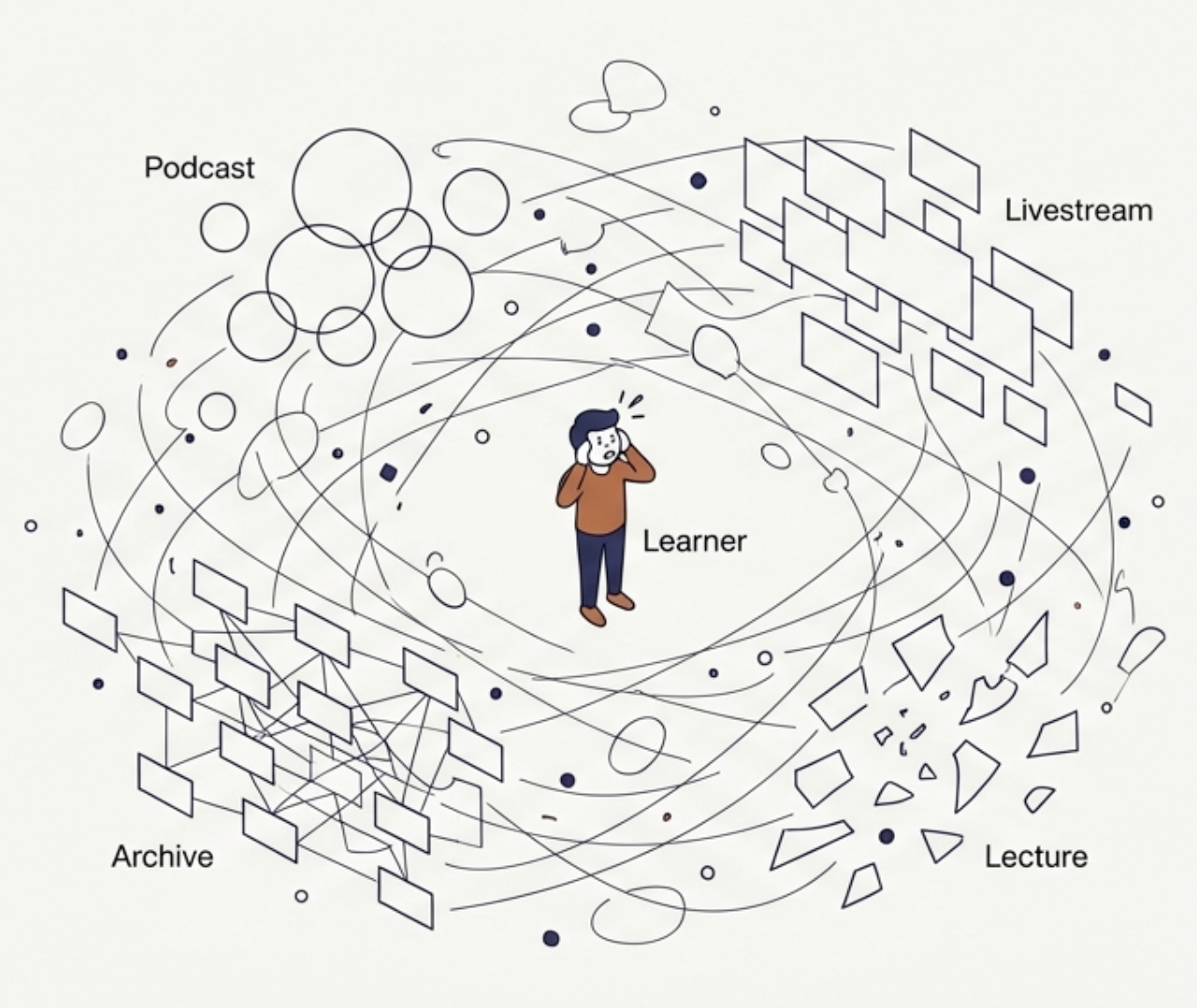
We are living through a historical paradox. The Golden Age of Access to Information has ushered in a Dark Age of Retention.
In the learning dimension, video is a uniquely rich medium. It combines accessibility, control, trust, demonstration and narrative into a singularly compelling experience. Millions of people rely on it for personal and professional development in rapidly advancing fields. Thousands of hours are uploaded daily, with infrastructure investment and incentives for creators measured in the billions of dollars.
Yet despite all of this, video has a major structural problem: It’s a linear, time-bound medium.
Information appears and then vanishes. You must absorb it in real-time. You can’t easily navigate it, save it or refer to it. You watch a brilliant explanation, feel that satisfying click of understanding, only to find that moments later the insight has faded.
In cognitive psychology, this problem is called the Transient Information Effect.
For three decades, Professor Richard E. Mayer’s seminal Cognitive Theory of Multimedia Learning has shown us how to scaffold content effectively. His 12 Principles of Multimedia Learning provide the framework for creators to structure content for maximum comprehension.
The problem is that, for thirty years we’ve poured high-quality instruction into a medium with a structural flaw. That’s like pouring high-octane fuel into a tank with holes in it. On top that, there’s a newer, deeper layer to the problem — modern video is no longer just carefully authored content. It’s raw streams, expert panels, and unscripted conversations.
Mayer’s 12 Principles solve the creator’s problem in a controlled environment. The modern learner faces a forager’s problem in a boundless one. There is a structural gap between the science of retention and the reality of consumption.
This gap is not about better content. It is about a better interface between the mind and the medium. A layer that applies cognitive design not at the moment of source creation, but at the moment of viewer interaction.
The following framework defines that layer and provides the principles to transform any video into a navigable, persistent, and actionable artifact.
I call this framework the Cognitive Design Layer.
Distinguishing The Two Layers
To understand this gap, we must distinguish between two fundamentally different loci of cognitive design: the Source Layer and the Interaction Layer.
1. The Source Layer (Authoring)
This is the domain of the creator. When a professor records a lecture or a podcaster edits an interview, they are making Authoring decisions. They decide what to include, what to remove, how to signal importance, and how to segment the information in the video.
Mayer’s 12 Principles are the definitive guide for this layer.
They are Passive-Prescriptive: they tell the creator how to design a message for a passive recipient.
2. The Interaction Layer (Engagement)
The modern learner’s reality is more complex.
In addition to high quality instruction, primary sources often include 3-hour unscripted podcasts, expert panels, and live streams — content created for engagement or broadcast.
This is where the Cognitive Design Layer operates. It focuses on the moment of consumption.
Its principles are Active-Adaptive — enabling the viewer to make sense of unstructured information quickly and retain what matters to them specifically.
| The Source Layer (Mayer) | The Interaction Layer (CDL) | |
|---|---|---|
| Focus | Authoring/Creation | Engagement/Consumption |
| Actor | The Creator | The Viewer |
| Problem | How to design the optimal message | How to extract meaning from any message |
| Principles | Passive-Prescriptive (Rules for optimal content structure) | Active-Adaptive (A system for optimal environment structure) |
| Temporal Scope | The moment of production | The moments of consumption, navigation and synthesis |
| Goal | Design the optimal content structure | Extract meaning from any content |
The CDL is not a replacement for Mayer’s Principles; it is their extension in a new era.
It answers the question: How do we apply cognitive design principles to any video content — regardless of its design quality?
It has one key challenge. To work, it must be machine-executable.
A Practical Architecture
The CDL builds on decades of work in Cognitive Load Theory, Multimedia Learning Theory, Distributed Cognition, and Human-Computer Interaction (HCI), converging them into a practical architecture.
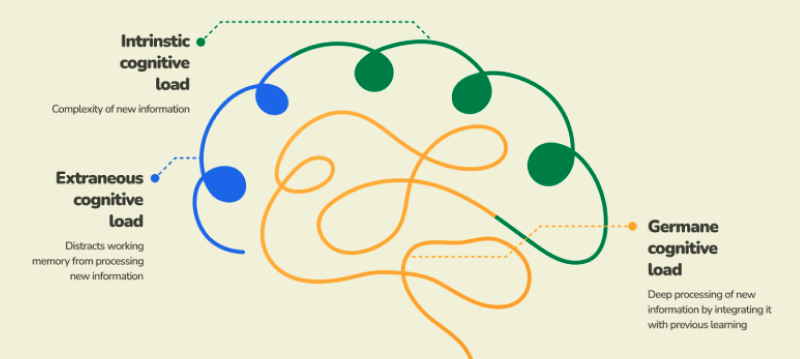
Learners today face crushing extraneous cognitive load (the mental effort wasted on non-essential tasks like searching, extracting, saving and retrieving information), which steals resources from intrinsic cognitive load (the inherent complexity of new information) and germane cognitive load (the deep processing of new information by integrating it with previous learning).
Video compounds this problem through the aforementioned Transient Information Effect. Learners must hold, process, and integrate new information simultaneously in working memory. The CDL solves this problem by making video persistent, navigable, and queryable — just like text.
Through its eighteen principles, it systematically transfers extraneous cognitive load from the viewer’s mind to the machine, transforming a high-friction, memory-intensive process into a low-friction, machine-supported one. Just like a calculator does for math.
While HCI has traditionally focused on usability , the CDL addresses a different challenge: transforming unstructured, passive video into structured, persistent information that supports ongoing synthesis and knowledge-building.
This represents a shift from designing for consumption to designing for synthesis. It moves beyond User Experience (UX), which optimises ease of operation, into what I call Epistemic Experience (EX) — designing the interface as an active partner in thinking, reasoning, and knowledge-building.
The Eighteen Principles
The CDL’s eighteen principles, across six functional categories, target specific cognitive friction points in video learning and offload them to the machine, making room for higher-order thinking.
1. Semantic Principles — How meaning is revealed
Understanding improves when signal stands out from noise. These principles surface what matters, letting viewers focus on comprehension rather than filtering.
- Coherence: Remove distractions and irrelevance
- Signalling: Make important moments obvious
- Orientation: Get an overview before engaging deeply
Evolution: Mayer’s Coherence and Signalling principles guide creators in designing clear messages. The CDL translates these into the interaction layer. The interface now filters noise and highlights signal, while Orientation extends Mayer’s Pre-Training principle into dynamic, learner-driven content preview. Control shifts from creator to viewer.
2. Contextual Principles — How context is preserved
Insights detached from their source are less valuable. These principles ensure every piece of information remains connected to its origin, making verification immediate and understanding complete:
- Spatial Contiguity: Keep related elements together
- Context Preservation: Every insight is tied to its source
- Source Transparency: Know where information comes from
Evolution: Mayer’s Spatial Contiguity principle ensures related information appears together during presentation. The CDL extends this principle into persistent infrastructure — every insight becomes a persistent portal back to its source moment. Context Preservation and Source Transparency are net-new principles: computational systems can trace provenance in ways creators cannot. This also prevents unwanted AI hallucinations as the AI has to reference the source video.
3. Temporal Principles — How you move through time
Linear playback forces you to watch in the creator’s sequence, not yours. These principles break viewers free from chronological constraint and let them navigate by thought, not time:
- Segmenting: Break long videos into meaningful parts
- Non-Linear Access: Jump straight to any concept
- Synchronisation: The object of focus and playback sync instantly
Evolution: Mayer’s Segmenting principle guides creators to break content into manageable chunks during production. The CDL automates this and adds Non-Linear Access and Synchronisation. These extend Mayer’s Temporal Contiguity into computed form: timestamps segment content automatically and sync playback, transforming video from a stream you watch into a space you explore.
4. Cognitive Load Principles: How mental effort is offloaded
Working memory is finite. Extraneous cognitive load steals resources from more valuable intrinsic and germane cognitive load. These principles transfer that burden to the machine:
- Multimodality: Audio, visuals and text reinforce each other and enable persistence
- Flexibility: Control what information you see dynamically
- Cognitive Offloading: Focus on understanding, not retrieval
Evolution: Mayer’s Modality principle optimises the balance between audio and visual channels during production. The CDL’s Multimodality and Flexibility extend this into user control. Cognitive Offloading is net-new: the interface handles nearly all extraneous load, freeing working memory for intrinsic and germane processing.
5. Organisational Principles: How knowledge compounds over time
Knowledge grows through connection and revision. Isolated insights lose their power to compound. These principles turn learning into a cumulative process where today’s understanding builds on previous learning:
- Agency: Direct your own learning path
- Organisation & Retrieval: Save and revisit insights effortlessly
- Compounding: Build on and reference previous learning
Evolution: Mayer’s Personalisation principle uses conversational tone to increase engagement during a single session. The CDL extends this into agency — learners control their entire learning path across time and sources. Organisation & Retrieval and Compounding are net-new — these principles only emerge when learning artifacts persist, accumulate, and remain queryable across sessions.
6. Social Principles: How understanding scales beyond you
Learning accelerates when you see how others think. In a boundless archive, deciding what’s credible and valuable is a cognitive burden. These principles leverage collective intelligence to surface what matters:
- Social Curation: Sources are curated by people, not just algorithms
- Distributed Expertise: Access insights from domain experts
- Social Signalling: See what your peers and experts find valuable
Evolution: These are net-new principles. Mayer’s framework assumes individual learners consuming content in isolation. The CDL enables collective intelligence. These principles only become possible when learning artifacts are shared, persistent, and linked. Individual insights become networked knowledge, validated by expertise rather than engagement metrics.
Individually, each principle above solves a specific point of friction. Together, they act as a coherent operating system, transforming the interface from a tool into an active thinking partner.
The Six Great Offloads
The Cognitive Design Layer functions as an energy management system.
The six categories manifest as six cognitive offloads — each transferring a specific burden from mind to machine.
1. Offloading Interpretation
Principles: Orientation, Coherence, Signalling
Video is, at its core, unstructured data. The viewer must manually infer structure, filter meaning and extract what’s valuable—performing real-time deciphering work that steals focus from understanding.
Shift: The CDL processes this unstructured data into structured information, providing the filter and the map. It handles signal retrieval, so the mind can focus on meaning.
Example: Chapters show the structure according to topic shifts. Highlights and Key Insights show the core “who, what and why”. Tabs dynamically display their timestamps as interactive markers on the Unified Timeline beneath the video, giving you an immediate overview of content density, pacing and structure.
2. Offloading Retrieval
Principles: Spatial Contiguity, Context Preservation, Source Transparency
Insights detached from their source are less valuable. Recovering the original context (the visual proof, the speaker’s tone, the preceding argument) requires a time-consuming additional act of labor.
Shift: Every insight is a portal to its source. The interface handles the reference, so the mind can focus on the insight.
Example: Every feature has its own tab in the AI panel and each output includes a clickable timestamp citation from the relevant moment in the video. Every insight is fused to its source.
3. Offloading Navigation
Principles: Segmenting, Non-Linear Access, Synchronisation
Finding a specific point in a linear timeline is guesswork. “Scrubbing” forces the brain to juggle search and comprehension simultaneously, draining working memory.
Shift: Content is indexed automatically. The learner navigates by thought, not by time. The interface handles the navigation, so the mind can focus on the content.
Example: In a 2-hour lecture on neural networks, you can search “backpropagation,” see every mention and its location on the Unified Timeline, and jump directly to the 14:32 explanation, without scrubbing or guessing.
4. Offloading Execution
Principles: Multimodality, Flexibility, Cognitive Offloading
Juggling video, transcripts, and notes while managing different levels of detail is “busy work” that often exceeds the brain’s processing limits, interfering with comprehension.
Shift: The interface adapts to the specific task — modalities and complexity are user-controlled. The tool handles the processing, so the mind can focus on synthesis.
Example: You’re following a complex lecture and need to save an important point. You click once to capture a timestamped note while the video plays, or simply ask the tool to create a comprehensive study guide for you. The interface handles the retrieval. You stay in flow.
5. Offloading Synthesis
Principles: Agency, Organisation & Retrieval, Compounding
Understanding requires building on prior learning. This is a memory-intensive process that stalls when there is unnecessary friction.
Shift: The interface becomes an external memory system. It manages the connections, so the mind can focus on the conclusions.
Example: You’re watching a 3-hour Huberman Lab podcast. You ask, “What does Huberman say about how dopamine levels affect mood?”. The interface shows all six mentions, with breakdowns of what was said, context and conclusion. You can see how his thinking evolved across the conversation, and can revisit these moments any time you want to.
6. Offloading Discovery
Principles: Social Curation, Distributed Expertise, Social Signalling
In a boundless archive, deciding what is credible is a demanding task. It’s a meta-cognitive burden that discourages exploration.
Shift: The interface leverages collective intelligence. It surfaces what the network has already validated. The tool handles the curation, so the mind can focus on discovery.
Example: You’re learning AI ethics. Instead of sifting through algorithmic recommendations, you follow researchers whose work you trust. When they publish a notebook on the topic, you see their curated videos, their notes, and their answered questions. They’ve done the curation work for you.
Note on Cognitive Offloading and Active Engagement
Research on cognitive offloading (Risko & Gilbert, 2016; Sparrow et al., 2011) has shown that over-reliance on external memory can reduce internal recall. Users remember where information is stored rather than the information itself.
This is a valid consideration for any system that externalises cognitive work.
The CDL addresses this through its Agency and Compounding principles. The interface handles retrieval logistics but not meaning-making. The goal is augmentation of thought, not replacement of it.
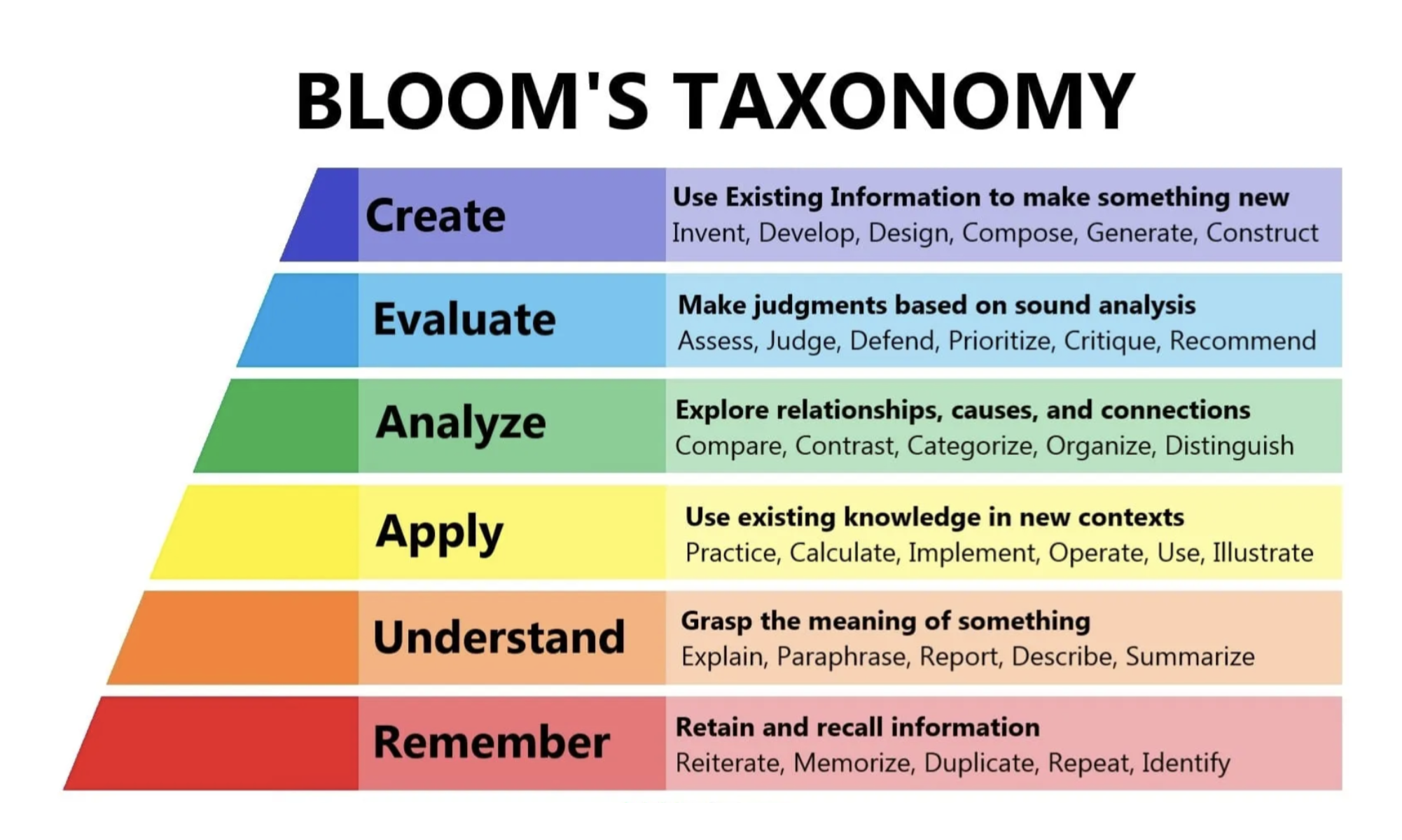 Bloom’s Revised Taxonomy pyramid, emphasising progression from lower to higher-order skills
Implications
By offloading lower-order cognitive tasks (see Bloom’s Taxonomy above), the CDL creates space for higher-order thinking.
Its true power is that it is machine-executable. When cognitive principles are encoded into software, they move from being strategies a learner must remember to properties of the environment they inhabit.
This is the jump from aerodynamics as theory to the airplane as infrastructure.
The following ten shifts represent the hypothesised outcomes of applying the framework at scale. Plausible effects grounded in theory, but still requiring empirical validation:
- A New Cognitive Baseline: Comprehension no longer depends solely on the creator’s instructional design quality. Learning becomes interface-determined, not content-determined.
- Systemic vs. Skill-Based Load Management: Good learning practice becomes a default state enabled by the interface, rather than a taxing achievement of the viewer.
- Video as an Interrogable Medium: Video transforms from a temporal artifact you must re-watch into a semantic repository you can query. Insights become addressable atoms, not fleeting impressions.
- Reduction of Cognitive Costs: The costs of discovery, navigation, and manual synthesis are dramatically reduced. The learning economy moves from attention-intensive to comprehension-efficient.
- Epistemic Co-Processor: The interface becomes a thinking partner that structures, connects, and surfaces context alongside you.
- Scalable Collective Intelligence: Individual insights are automatically contextualised and preserved. Scattered individual insights become structured collective intelligence.
- Video as a Citable Substrate: Video is no longer a passive stream; it is a map, a node, and a referenceable substrate for thought.
- Interaction-Layer Field: The CDL establishes a new academic field at the intersection of cognitive science and human-computer interaction.
- The Cognitive Standard: Once a cognitive interface is experienced, “flat” video will feel incomplete, akin to mobile browsing without mobile rendering.
- Democratisation of Expertise: High-resolution learning becomes dramatically more accessible, lowering the talent barrier to effective knowledge work.
The Meta-Implication:
Together, these mark the transition from an environment where the learner adapts to the medium, to an environment where the medium adapts to the learner.
From Theory to Interface
The value of this framework depends entirely on its ability to be machine-executable. Encoding its principles into scalable software has been a challenging, rewarding task.
Every principle described here is seamlessly embedded into YouNote, The Thinking Partner for Video. The result is a production grade implementation of the Cognitive Design Layer — a product of what happens when software engineering meets scientific rigor.
The goal is to overcome video’s structural problem of transience and turn it into a citable substrate for human thought and expression.
We now have the foundational infrastructure — a cognitive interface that treats the learner not as a passive recipient, but as an active participant.