
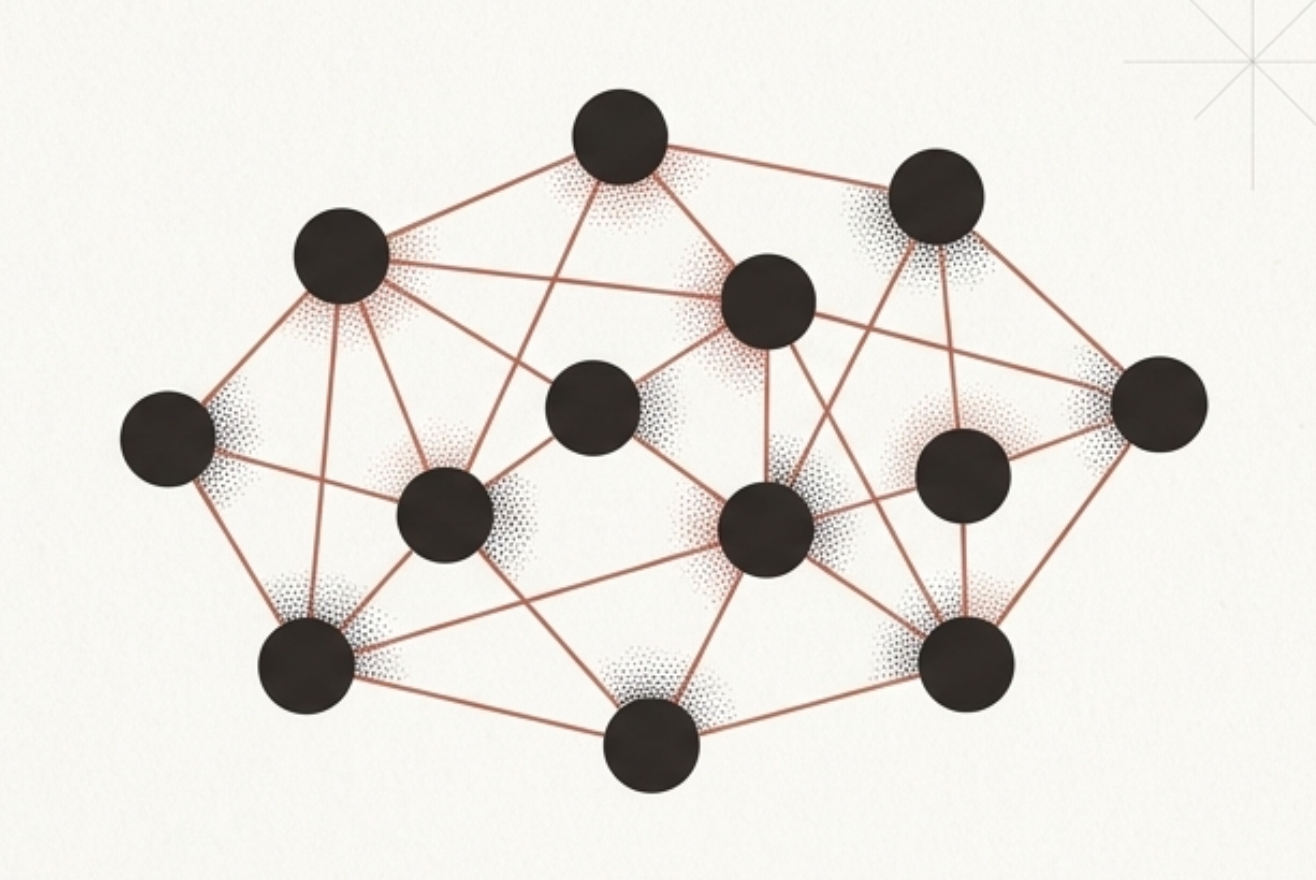
Your mind doesn’t move through time. It moves through meaning.
This seems obvious once you notice it.
You don’t remember information in the order it was delivered. You remember the moment something clicked — the instant an abstract idea became concrete.
That moment is called schema formation (1) — when a new idea connects to something you already know. This process is inherently non-linear — it requires wandering (2) through a network of existing ideas and information until the connection snaps into place
Yet every learning medium we have is linear. Books move from the first page to the last. Lectures start and end. Video runs sequentially.
Sequence and narrative are important — but the fundamental structure doesn’t align with the mind’s need to traverse ideas freely and form connections.
We seem to have accepted this as the nature of the medium. It isn’t.
If the mind learns non-linearly, why is media linear?
Andy Matuschak has thought about this problem more carefully than almost anyone today. He helped build iOS at Apple and led R&D at Khan Academy.
His central argument is simple: understanding is memory-bound.
You cannot reason with what you cannot recall. The moment of insight only happens if the pieces are in memory, waiting to be connected.
His prescription follows naturally. Don’t just consume. Retrieve. Build systems that return ideas to you when memory needs reinforcement.
Externalising memory means that you can revisit moments on-demand and incorporate them into long-term memory — which is effectively limitless (3).
It’s serious, careful work. And it has almost entirely been applied to one medium — text.
The tools-for-thought movement has largely been built around reading — because text is the medium serious thinkers have always used. This is because it has one property that makes everything else possible — it stays still. You can navigate it at the speed of your comprehension.
Video, for example, does not stay still. It plays. It’s transient.
The insight at minute four is buried by minute fourteen — replaced by whatever comes next. You cannot easily search, skim or navigate it.
Yet video is the richest, most accessible learning medium we’ve ever created.
It transmits not just arguments, but texture — emotion, timing, body language, and demonstration. It engages more of your senses. And increasingly, it’s how the world consumes information.
The asymmetry is striking. The richest medium is also the most fragile. Before working memory can consolidate what it just received, the next frame has already arrived.
This is a structural flaw in the medium. And it has a name — the Transient Information Effect.
This effect happens when information disappears before you can process and integrate it.
Working memory is the bottleneck. It holds roughly four pieces of information at a time, for only a few seconds.
Text respects this. Sentences stay on the page. If your working memory is maxed out, you can go back. The medium and the mind are, at least roughly, in negotiation.
Video does not negotiate. It runs on its own schedule. And as it runs, it generates something that feels exactly like understanding — the sense of following, keeping up, things making sense — while quietly ensuring that most of what just made sense will be gone by morning.
Think about it. How much can you recall from the last podcast you watched?
Whatever bits and pieces you remember are linked to an existing schema you have. Everything else fades.
The feeling of learning and the act of learning are not the same thing.
Video excels at producing the feeling. It fails to produce the act.
Here is what changes when you solve this.
Matuschak’s vision of more people becoming multidisciplinary, connecting easily to past experiences and creative breakthroughs emerging from unexpected connections (4) — depends entirely on retaining what you learn.
What if we could externalise memory and retrieval, so you could focus on connection and synthesis?
What if text and video were dynamically combined, each medium contributing what the other lacks: text’s permanence and navigability, video’s richness and tacit knowledge?
Video is how the world gets much of its information, yet it has never had the infrastructure to retain it. We envision a future where video is as referenceable as text. Tap the links below to see how we’re solving this problem.
Moments:
- Justin Sung — Schema formation
- Jeff Bezos — Wandering
- Dr. John Sweller — Long-term memory
- Andy Matuschak — Creative breakthroughs